
3 Containment Mistakes That Cost Restoration Companies Money
In restoration work, containment isn't just about meeting standards—it's about protecting your profitability. The way you approach containment directly impacts project timelines, labor costs, and your ability to take on more work.
Yet many restoration professionals make the same containment mistakes that quietly drain revenue on every job. These aren't obvious failures—they're subtle inefficiencies that add up over time and across dozens of projects.
Here are three common containment mistakes that cost restoration companies money, and how to fix them.
Mistake #1: Relying on Disposable Materials for Every Job
The most expensive containment mistake is also the most common: buying plastic sheeting and tape for every single restoration project.
It seems budget-friendly in the moment. A few rolls of plastic, some tape, and you're ready to build containment. But those costs repeat on every water damage restoration, mold remediation, and demolition job you handle.
Calculate what you actually spend per month on disposable containment materials. Then multiply that by twelve. For most restoration companies, the annual cost is significant—and it's completely avoidable.
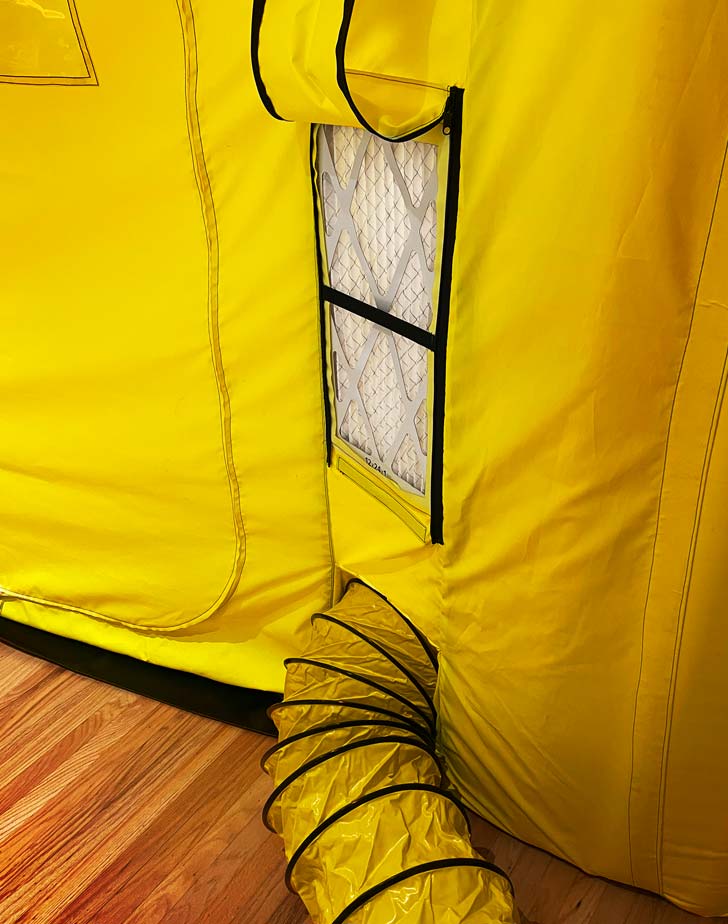
The Fix: Reusable containment systems eliminate recurring material purchases. You invest once in professional-grade barriers like AIRWALL® that work job after job, year after year. The initial investment pays for itself quickly, and everything after that is pure savings.
For restoration professionals running high volumes of work, switching to reusable containment is one of the fastest ways to improve margins without changing how you price jobs.
Mistake #2: Underestimating Setup and Repair Time
Traditional containment takes time—more time than most contractors account for when pricing jobs or planning schedules.
Your crew spends hours measuring doorways, cutting plastic to size, taping edges, re-taping sections that fail, and repairing tears during the project. All of that is non-billable labor that eats into your profitability.
Worse, when containment fails mid-project, work stops. Your team can't continue restoration work safely until containment is repaired and negative pressure is restored. Those delays cost money and push back your entire project timeline.
The Fix: Fast containment deployment changes the equation. AIRWALL systems are designed for quick setup without constant measuring, cutting, and taping. Most installations take a fraction of the time traditional methods require.
When setup time drops from hours to minutes, your crew can begin extraction, drying, or remediation work faster. Faster project starts mean better turnover—and better turnover means more jobs per month without adding headcount.
The restoration companies that minimize time spent on containment setup are the ones that maximize billable hours and profitability.
Mistake #3: Accepting Containment Failures as "Normal"
Here's a mistake many restoration professionals don't even recognize: treating containment failures as an inevitable part of the job.
Plastic tears. Tape loses adhesion. Barriers sag. And when that happens, crews stop what they're doing to make repairs. It's so common that many contractors just accept it as "the way things are."
But containment failures aren't normal—they're a sign that your containment system isn't adequate for professional restoration work.
Every time containment fails:
- Work stops while repairs are made
- Cross-contamination risk increases
- Project timelines extend
- Client confidence drops
Those failures have real costs, even if they're hard to quantify precisely.
The Fix: Professional reusable containment is engineered to hold consistently throughout the entire project. AIRWALL barriers rely on air pressure, compression, and friction to create stable containment that can outperform plastic by 200-400% when it comes to holding negative pressure.
When containment holds reliably from start to finish, your crew can focus on restoration work instead of constantly managing barrier failures. Fewer interruptions mean faster project completion and better outcomes.
The Real Cost of These Mistakes
What makes these three mistakes particularly expensive is that they compound across every project.
One job where you buy disposable materials, spend extra time on setup, and deal with containment failures might not seem catastrophic. But multiply that pattern across 50 or 100 restoration projects per year, and the cumulative impact on profitability is substantial.
The restoration companies that recognize these patterns and make the switch to professional reusable containment report:
- Significant reduction in containment-related costs
- Faster project timelines due to quicker setup and fewer failures
- Higher team morale because crews aren't fighting containment problems all day
- Better client relationships thanks to more reliable, professional jobsite control
Moving Forward
The good news is that all three of these containment mistakes are fixable with one decision: upgrading to a reusable containment system designed for the demands of restoration work.
When your containment approach eliminates recurring material costs, deploys quickly, and holds reliably throughout projects, those improvements flow straight to your bottom line.
Explore AIRWALL's complete line of reusable containment solutions at https://www.zeppelinguys.com/store and see how professional containment supports better profitability on every restoration job.


.png)